WELCOME BONUS 300%
UP TO €2000 + 100
FREE SPINS
UP TO €2000 + 100
FREE SPINS
Home → Roulette
Roulette at Frank-Casino
When is it Worth Switching to French Roulette?
French Roulette, French Roulette (La Partage applies to even money bets) offers a superior RTP of 98.65%, significantly reducing the house edge to 1.35%. This contrasts with standard French and European Roulette variants, which maintain a 2.70% house edge due to the absence of the La Partage rule on inside bets. For high rollers, this reduction in house edge is crucial for long-term play.
The La Partage rule in French Roulette specifically benefits players by refunding half of the stake on even money bets (Red/Black, Odd/Even, Low/High) when the ball lands on zero. This rule is not applied to inside bets, which retain the standard European Roulette payouts and house edge. Understanding this distinction is vital for strategic betting.
Switching to French Roulette with La Partage for even money bets can protect a significant portion of a high roller's bankroll over extended playing sessions. While inner bets maintain a 35:1 straight-up payout, the 1.35% house edge on even money bets is a substantial advantage compared to the 2.70% found in standard European Roulette.
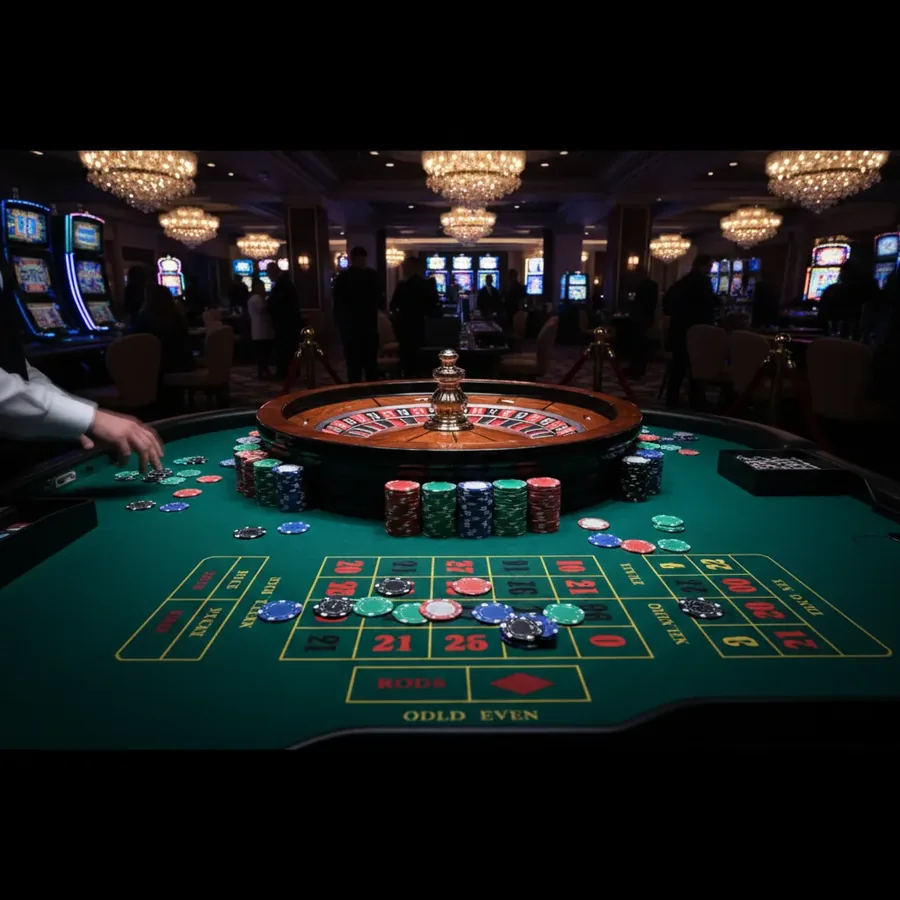
Wheel Speed and Ball Toss in Real Wheel
Live dealer roulette tables, such as Quantum Roulette Live and Mega Fire Blaze Roulette Live from Playtech, offer betting limits up to €5,000 per round. These high stakes cater to players seeking substantial action, where the speed of the wheel and the ball toss directly influence the pace of play and the frequency of betting opportunities.
The RTP for Quantum Roulette Live is stated at 97.30%, a figure consistent with standard European Roulette, indicating that multipliers do not inherently alter the theoretical return to player. The inclusion of Quantum multipliers up to 500x on 1-5 numbers introduces volatility but the base game mechanics remain aligned with a 2.70% house edge.
For players engaging with high betting limits, the consistency of the ball toss and wheel spin in live environments becomes paramount. While multipliers can dramatically increase potential payouts, the fundamental odds of European Roulette (37 sectors, 2.70% house edge) underpin every bet placed on these live tables.
36 Instead of 37: The Math Behind 35:1
The payout of 35:1 for a straight-up bet on a single number in Roulette is based on the premise of a 36-sector wheel, ignoring the zero. However, European Roulette actually features 37 sectors, including a single zero, resulting in a theoretical house edge of 2.70% if payouts were adjusted to reflect this. The 35:1 payout on a 37-sector wheel is a critical factor in the game's mathematical structure.
This standard payout structure, where a 35:1 for a single number bet is offered on a wheel with 37 slots (numbers 1-36 plus 0), leads to the inherent house advantage. If the wheel truly had only 36 sectors and no zero, a 35:1 payout would represent a fair game with no house edge.
The discrepancy between the 36 'paying' sectors implied by the 35:1 odds and the actual 37 sectors on a European wheel creates the house advantage. This fundamental mathematical principle is why casinos maintain profitability, even with high payouts on individual bets like the straight-up 35:1.
How Payout Odds 35:1 Are Achieved
The 35:1 payout for a straight-up bet in Roulette is achieved by offering a payout that corresponds to the number of non-winning outcomes for that specific bet. On a European wheel with 37 sectors, there are 36 other outcomes besides the chosen number. The casino pays 35 units for every 1 unit wagered, plus the original stake back.
This payout structure is standard across most European and French Roulette variants, including those offered at Frank-Casino. For example, the French Roulette variant (without La Partage on inside bets) and the standard European Roulette both feature this 35:1 payout for straight-up bets, contributing to their 2.70% house edge.
The mathematical outcome is that for every 37 units wagered on a single number, the casino expects to pay out 36 units (35 to the winner, plus the original 1 unit stake returned). This leaves a net of 1 unit for the house, representing the 2.70% edge on that particular bet.
Too High a Bet for a 50 EUR Bankroll
A €50 bankroll is significantly challenged by the high betting limits available on live roulette tables, which can extend up to €5,000. Placing a bet on a high-stakes table with such a limited bankroll would mean a substantial portion of the total funds is wagered on a single spin, severely increasing risk.
Consider the €2,000 welcome bonus offered alongside a 300% match. While this provides a larger initial sum, wagering requirements must be met. Table games, including roulette, contribute only 10% to bonus wagering, meaning a €50 bet would contribute just €5 towards the requirement.
A €50 bankroll is generally insufficient for high-roller stakes, especially when considering the 10% game contribution for table games towards wagering requirements. For example, to wager through a €2,000 bonus, a player would need to place €20,000 in table game bets, which is an unrealistic target for a €50 initial stake.
Roulette bet types at a glance
| Bet | Payout | Win Chance | Numbers Covered | House Edge |
|---|---|---|---|---|
| Roulette Französisch mit La Partage (gerade Chancen) | Rot/Schwarz 1:1 (bei 0 Rückerstattung 50%), Odd/Even 1:1, Low/High 1:1; Innere Einsätze ohne La Partage: Straight 35:1, Split 17:1, Street 11:1, Corner 8:1 | 98.65% | Bei 0 wird die Hälfte des Einsatzes auf gerade Chancen zurückerstattet (Rot/Schwarz, Pair/Impair, Manque/Passe). En Prison gibt denselben 1,35%. Regel gilt NUR für gleiche Einsätze | 1.35% |
| Roulette Europäisch (einfache Null, 37 Sektoren) | Straight 35:1, Split 17:1, Street 11:1, Corner 8:1, Six Line 5:1, Dozen 2:1, Column 2:1, Rot/Schwarz 1:1, Odd/Even 1:1, 1-18/19-36 1:1 | 97.30% | 37 Sektoren (1–36 + 0); Auszahlungen wie für 36 Sektoren – daher konstanter Edge auf ALLE Wetten | 2.70% |
| Roulette Amerikanisch (doppelte Null, 38 Sektoren) | Straight 35:1, Split 17:1, Street 11:1, Corner 8:1, Six Line 5:1, Dozen 2:1, Column 2:1, Rot/Schwarz 1:1 | 94.74% | 38 Sektoren (1–36 + 0 + 00); Auszahlungen wie beim europäischen Rad, aber der zusätzliche Sektor verdoppelt den Hausvorteil | 5.26% |
| Roulette Amerikanisch – Five Number Bet (0, 00, 1, 2, 3) | Five Number 6:1 (deckt 5 von 38 Sektoren) | 92.11% | Einzige Wette am amerikanischen Rad mit Edge über 5,26% – „Fallenwette“. Kein Äquivalent am europäischen Rad | 7.89% |
| Roulette Französisch, innere Einsätze (La Partage gilt nicht) | Straight 35:1, Split 17:1, Street 11:1, Corner 8:1, Six Line 5:1, Dozen 2:1, Column 2:1 | 97.30% | Rad gleich (37 Sektoren), aber La Partage/En Prison gilt nicht für innere Einsätze – Edge bleibt europäisch | 2.70% |
How Long is a Betting Phase at a Live Table?
The betting phase at live tables, such as Quantum Roulette Live, is defined by its upper wager limit, which is set at 5,000 EUR. This substantial ceiling caters to players who prefer higher stakes during their gameplay sessions.
Players can participate with wagers starting from a minimum of 0.10 EUR, allowing for a broad spectrum of betting strategies across various live roulette variants. This flexibility ensures that both cautious players and high rollers can find a comfortable entry point for their wagers. The betting phase concludes before the ball is spun.
The maximum potential payout in Mega Fire Blaze Roulette Live, reaching up to 10,000x the stake, highlights the significant financial possibilities available to players. While the betting phase duration is variable, the potential for such large returns makes understanding the betting limits crucial for strategic play. The stated RTP for this game is 97.30%.
Why 5.26 Percent is Rarely Recommended
A house edge of 5.26 percent is associated with American Roulette, a variant featuring both a 0 and a 00 sector. This higher house edge means that, on average, players can expect to lose more of their wagers over the long term compared to other roulette versions. The RTP for this variant is 94.74%.
The disadvantage for players is particularly pronounced with the Five Number Bet in American Roulette, which carries an exceptionally high house edge of 7.89%. This specific bet covers the 0, 00, 1, 2, and 3 sectors, offering a payout of 6:1. It is the only bet on the American wheel with an edge over 5.26%.
In contrast, European Roulette and French Roulette variants typically offer a house edge of 2.70% or even 1.35% with the La Partage rule. The presence of only a single zero sector in these versions significantly reduces the house advantage, making them generally more favorable for players. The RTP for European Roulette is 97.30%.
Error: Expecting La Partage at the Wrong Table
The La Partage rule, which refunds half of an even-money bet when the ball lands on zero, is a feature of specific French Roulette variants. Its absence on other roulette tables means players might not receive this partial refund, altering the expected return on their bets. This rule applies only to even-money bets.
For instance, French Roulette with La Partage offers an RTP of 98.65% on even-money bets, with a house advantage of 1.35%. However, if one plays standard European Roulette, the house edge is 2.70% for all bets, including even-money ones, as the La Partage rule is not in effect. This difference is significant for strategic players.
Players should verify the specific rules of each roulette table before placing bets, especially if they are accustomed to the benefits of La Partage or En Prison. Misunderstanding these rules can lead to unexpected losses, as the house edge can be considerably higher without these player-favorable conditions. For example, French Roulette without La Partage has an RTP of 97.30%.
Quantum Roulette: Which Numbers Get Multipliers
Quantum Roulette, a variant offered by Playtech, introduces the excitement of multipliers that can significantly boost potential winnings on specific numbers. These multipliers are applied randomly to a selection of numbers on the roulette wheel during each game round. The game features 37 sectors, similar to European Roulette, but with the added dynamic of quantum multipliers.
The Quantum Roulette Live variant also features these multipliers, with the potential to increase payouts on one to five numbers per round. These multipliers can reach up to 500x the player's bet, adding a thrilling layer of unpredictability to the standard roulette gameplay. The RTP for this live variant is stated as 97.30%.
While the exact selection of numbers receiving multipliers can vary from spin to spin, the presence of these boosted payouts is a core feature of Quantum Roulette. This mechanic differentiates it from traditional roulette games, offering a chance for larger wins on individual bets, even though the base payout for a Straight bet remains 35:1.
Multipliers up to 500x Lower the Base Payout
The inclusion of multipliers in games like Quantum Roulette, which can reach up to 500x, does not alter the fundamental payout structure for standard bets. For example, a Straight bet on a number still pays 35:1 if no multiplier is applied, reflecting the base odds of the game. This is consistent across many roulette variants.
However, when a multiplier is active on a chosen number, the payout for a winning bet on that specific number is amplified by the multiplier amount, up to the specified maximum. For instance, if a 500x multiplier is active on a number and a player bets €10 on it, a win would yield €350 (base payout) plus the multiplier bonus, potentially leading to a very substantial payout.
It is important to note that while multipliers offer the potential for significantly larger wins, they are applied on top of the standard payout. The RTP for Quantum Roulette Live is 97.30%, indicating the theoretical long-term return to player, irrespective of the multiplier feature. This RTP is consistent with other European-style roulette games.
House Edge 2.70 Percent in One Number
The house edge on European Roulette stands at 2.70 percent, with a payout of 35:1 for a straight-up bet on a single number. This figure represents the casino's theoretical advantage over the player on a wheel with 37 sectors, including a single zero. High rollers might prefer this variant for its lower built-in disadvantage compared to American Roulette. Understanding this edge is crucial for managing potential losses over extended play sessions.
American Roulette, conversely, features a house edge of 5.26 percent due to the inclusion of both a '0' and a '00' sector, also offering a 35:1 payout on single numbers. This doubles the casino's advantage on the same bet type. For players prioritizing lower house odds, the 2.56 percent difference is significant. Therefore, the choice between these two roulette variants directly impacts the long-term expected return of wagers.
The French Roulette variant, when La Partage is applied to even-chance bets, reduces the house edge to 1.35 percent. This occurs when the ball lands on zero, with half the stake returned on even-chance bets like red/black or odd/even. This mechanic significantly benefits players focused on outside bets. This specific rule makes it a highly attractive option for high rollers seeking to minimize risk on frequent wagers.
Even Chances vs Straight: Variance Comparison
A straight-up bet on a single number in European Roulette, with a 35:1 payout, offers higher potential rewards but also greater volatility. The theoretical RTP for this bet is 97.30%, reflecting the 2.70% house edge. High rollers often balance the allure of big wins against the increased risk associated with such concentrated bets. The frequency of wins on these bets is considerably lower than on outside wagers.
Conversely, even-chance bets such as red/black or odd/even in European Roulette pay 1:1, offering lower individual payouts but much higher hit frequency. The RTP for these bets remains 97.30% when La Partage is not applied to them. This consistency makes them a popular choice for players seeking to maintain their bankroll over longer gaming periods. Their lower variance is a key consideration for strategic betting.
When comparing these betting strategies, a high roller must consider their risk tolerance and desired play duration. A series of straight-up bets can lead to rapid gains or losses, whereas a prolonged sequence of even-chance bets will generally result in a more gradual erosion of funds due to the house edge. The 'Five Number Bet' in American Roulette has a significantly higher house edge of 7.89%, making it generally less favourable.
Betting Window Missed: What Happens to the Chip
If a player misses the betting window for a live roulette game, their chip typically remains on the table for the next spin. For instance, in Quantum Roulette Live, with stakes ranging from 0.10 EUR to 5,000 EUR, a missed bet simply carries over. This means the wager is placed on the subsequent round of play. Players should be mindful of the speed of live dealer games to avoid this.
In situations where a bet is inadvertently placed on the wrong outcome or a player wishes to retract a wager after the betting window closes, casino policies can vary. However, generally, once the dealer calls 'no more bets', all wagers are final. This is particularly relevant for high rollers placing substantial sums on live tables.
The consequence of missing the betting window is simply the deferral of the wager to the next available spin. This system ensures fair play by preventing late adjustments to bets once the outcome is becoming apparent. For high rollers, understanding this process is key to managing their betting rhythm and ensuring their intended wagers are placed effectively.
Error: 10 Percent Contribution to Wagering Missed
Table games, including roulette variants like European and American Roulette, typically contribute only 10 percent towards bonus wagering requirements. This means that for every 100 EUR wagered on a table game, only 10 EUR counts towards clearing the bonus. This is a critical term for high rollers aiming to utilize bonus funds effectively. It significantly extends the time and amount required to meet the turnover.
The welcome bonus offers 300% up to 2,000 EUR plus 100 free spins, but the low contribution rate for table games makes it challenging to clear for those who prefer roulette. For example, to wager a 2,000 EUR bonus with a 40x requirement, a player would need to bet 80,000 EUR. If table games only contribute 10%, this equates to 800,000 EUR wagered on roulette.
High rollers who primarily play roulette should be aware of this 10% contribution rate. It suggests that prioritizing free spins or other bonus eligible games might be more efficient for clearing bonus funds. Understanding these terms is paramount to avoid disappointment and to strategize bonus utilisation effectively. The actual RTP of the games is secondary to the wagering contribution percentage in this context.
D'Alembert and Fibonacci Against the Same Table Limit
Betting strategies like D'Alembert and Fibonacci are progressive systems where stakes are adjusted based on previous outcomes. For example, in the D'Alembert system, a unit is added after a loss and subtracted after a win. The Fibonacci system follows the Fibonacci sequence for stake progression after losses. These systems are employed on roulette tables with varying payout structures.
The key limitation for high rollers employing such strategies is the table limit. For instance, a table might have a maximum bet of 5,000 EUR on Quantum Roulette Live. If a player following a progressive system experiences a long losing streak, their required bet could quickly reach this maximum limit, preventing further application of the strategy. The straight bet payout is 35:1.
The house edge of 2.70% on European Roulette and 5.26% on American Roulette will eventually impact any betting system, regardless of its complexity. Even with strategies designed to manage variance, the inherent advantage of the casino remains. High rollers must recognize that no betting system can overcome the fundamental mathematical edge of the game over the long term.
Contact
Live - online chat
Banking









Providers












Frank Casino 2026